When you are facing a chaotic highway collision, understanding the baseline rules of the road determines how you recover. Drivers who operate a vehicle with complete indifference to human life cross a major boundary. This behavior bypasses standard traffic infractions and moves straight into a dangerous criminal tier. Have you been in a reckless driving incident?
Key Takeaways
- Willful Disregard Rules: Recklessness requires intentional, dangerous behavior rather than a momentary lapse in driver attention.
- Exceeding Speed Limits: Going 15 mph or more over standard posted limits often triggers criminal classifications.
- Civil Claim Impact: Securing a reckless driving conviction against the at-fault motorist significantly strengthens your personal injury lawsuit.
- Punitive Financial Compensation: Victims can pursue distinct punitive damages designed purely to punish egregious road behavior.
What Legal Standard Defines a Reckless Driver?
The law defines reckless driving as operating any motor vehicle with a willful or wanton disregard for the safety of persons or property. This standard means the operator explicitly knew their erratic actions created a substantial, unjustifiable highway risk but chose to press the gas pedal anyway.
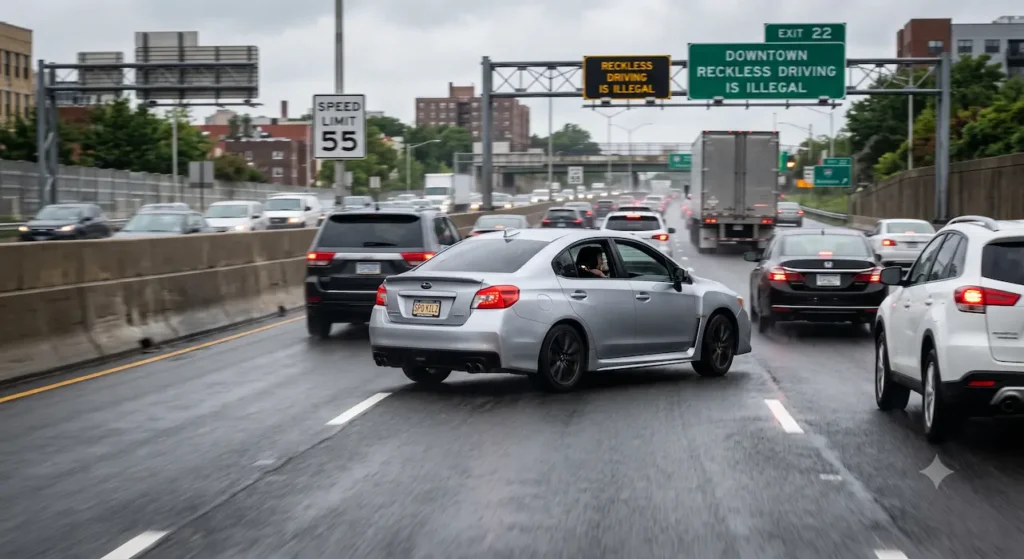
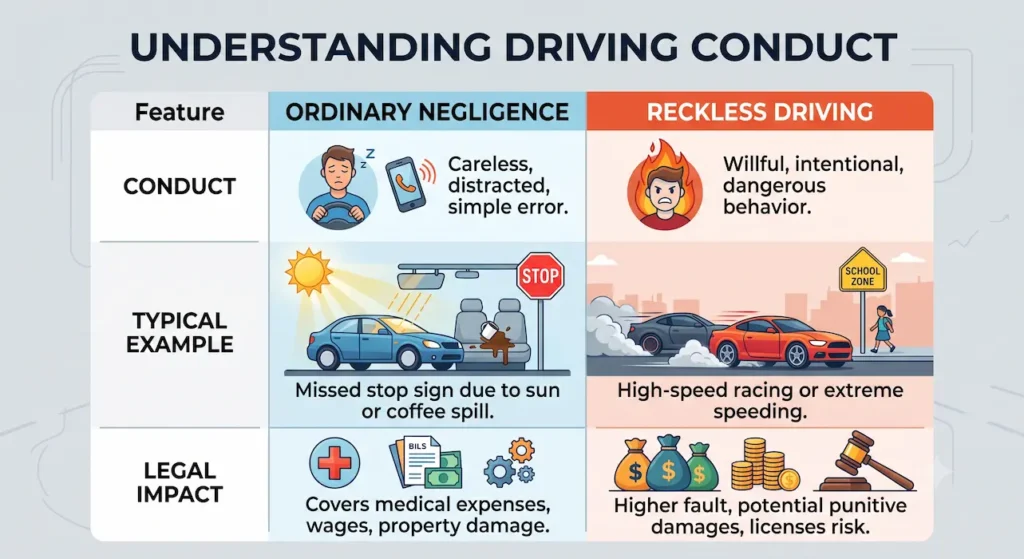
The reality on the ground is that this behavior represents a massive leap beyond simple everyday carelessness. For instance, a driver who glances down at a map and drifts out of a lane exhibits ordinary negligence. Conversely, an operator who actively weaves through congested commuter traffic at triple-digit speeds demonstrates a complete, intentional indifference to human consequences.
How Do Courts Separate Negligence From Recklessness?
Courts distinguish negligence from recklessness by examining the driver’s specific mindset and level of intent. Ordinary negligence involves a basic failure to use reasonable caution, while recklessness demands active, conscious risk-taking.
The Strategic Framework For Your Injury Claims
- Secure Immediate Documentation
- Call law enforcement to ensure a comprehensive accident report gets filed on-site.
- Request that responding officers detail specific aggressive actions like brake-checking or extreme tailgating.
- Lock Down Digital Evidence
- Subpoena heavy commercial vehicle electronic logging devices or passenger vehicle event data recorders.
- Extract timestamped cell phone records to prove conscious, dangerous driver distraction.
- Deploy Accident Reconstruction Experts
- Analyze highway skid marks and vehicle debris fields to calculate precise impact velocities.
- Recreate the crash sequence to demonstrate absolute willful disregard to a jury panel.
Contextual Categories of Aggressive Driving
Severe Operational Violations
- Street Racing: Engaging in timed speed competitions on public roadways without local municipal authority.
- Eluding Law Enforcement: Passing multiple vehicles blindly while actively fleeing a marked police cruiser.
Toxic Roadway Behaviors
- Brake-Checking: Slamming on brake systems deliberately to terrorize or intimidate following motorists.
- Threading Traffic: Weaving violently across lanes without using signals in dense highway bottlenecks.
Grounding Key Legal Terms
- Willful Conduct: Purposeful, deliberate behavior where the driver understands the inherent danger.
- Wanton Indifference: Complete disregard for the catastrophic injuries an action will likely cause.
- Punitive Damages: Extra financial penalties awarded to punish the offender rather than cover standard bills.
- Misdemeanor Criminal Charge: A formal criminal classification that carries real jail sentences and permanent records.
Homeowner & Driver Insight
Here’s the part most insurance adjusters won’t tell you: standard policy exclusions often complicate claims involving intentional acts, but because recklessness occupies the space between pure accidents and intentional assault, carriers typically must still pay out for your physical damages while the driver remains personally exposed to punitive awards.
Protecting Your Rights After a Crash
Putting your financial recovery strategy into motion requires aggressive legal action. Tenina Law steps in to handle the insurance corporations while you heal from your injuries. We gather the black box data, track down eyewitnesses, and build an ironclad case designed to maximize your final settlement.
Protect your rights now!
Contact Tenina Law immediately for your legal battles. We offer a free case review.

In a Hurry? Dial 213-596-0265 now!
Frequently Asked Questions
Q: Can speeding alone turn into a criminal reckless driving charge?
A: Yes, excessive speeding transitions into a criminal charge when the velocity vastly exceeds the safe limit for current conditions. While tracking slightly over the limit is an infraction, driving 20 mph or more above standard postings constitutes wanton disregard.
Q: What happens if a reckless driver hurts someone in a collision?
A: When reckless behavior causes bodily harm, the driver faces enhanced criminal penalties including mandatory jail time. The civil court system also permits victims to pursue substantial punitive damages to address their deep pain and suffering.
Q: Is distracted driving legally equivalent to a reckless action?
A: Extreme distracted driving rises to recklessness if the operator deliberately ignores known risks for an extended duration. Briefly glancing at a navigation screen counts as basic negligence, but continuous text messaging through heavy traffic fits the willful standard.
Q: How do personal injury lawyers prove a driver acted recklessly?
A: Injury attorneys establish clear recklessness by combining physical scene metrics with digital tracking technology. Dashcam footage, commercial black box printouts, and passenger cell phone downloads provide objective proof of a driver’s dangerous operational state.
Q: Will a driver’s criminal conviction help my civil injury lawsuit?
A: Yes, a traffic court conviction for a misdemeanor offense provides powerful leverage during your civil personal injury claim. It establishes a definitive record of egregious behavior, which prevents the insurance company from downplaying the driver’s underlying fault.