
Many families ask us the same thing after a parent or spouse passes away: is there an inheritance tax in California? The short answer is no. California does not charge an inheritance tax, and it does not have its own estate tax either. But that doesn’t mean an inheritance is always tax-free. Federal rules, property taxes, income taxes, and the laws of other states can still come into play. At Tenina Law, we help California families plan their estates and handle what comes after a loss, so here’s a plain look at how taxes really work when you inherit.
In a Hurry? Dial 213-596-0265 now!

Key Takeaways
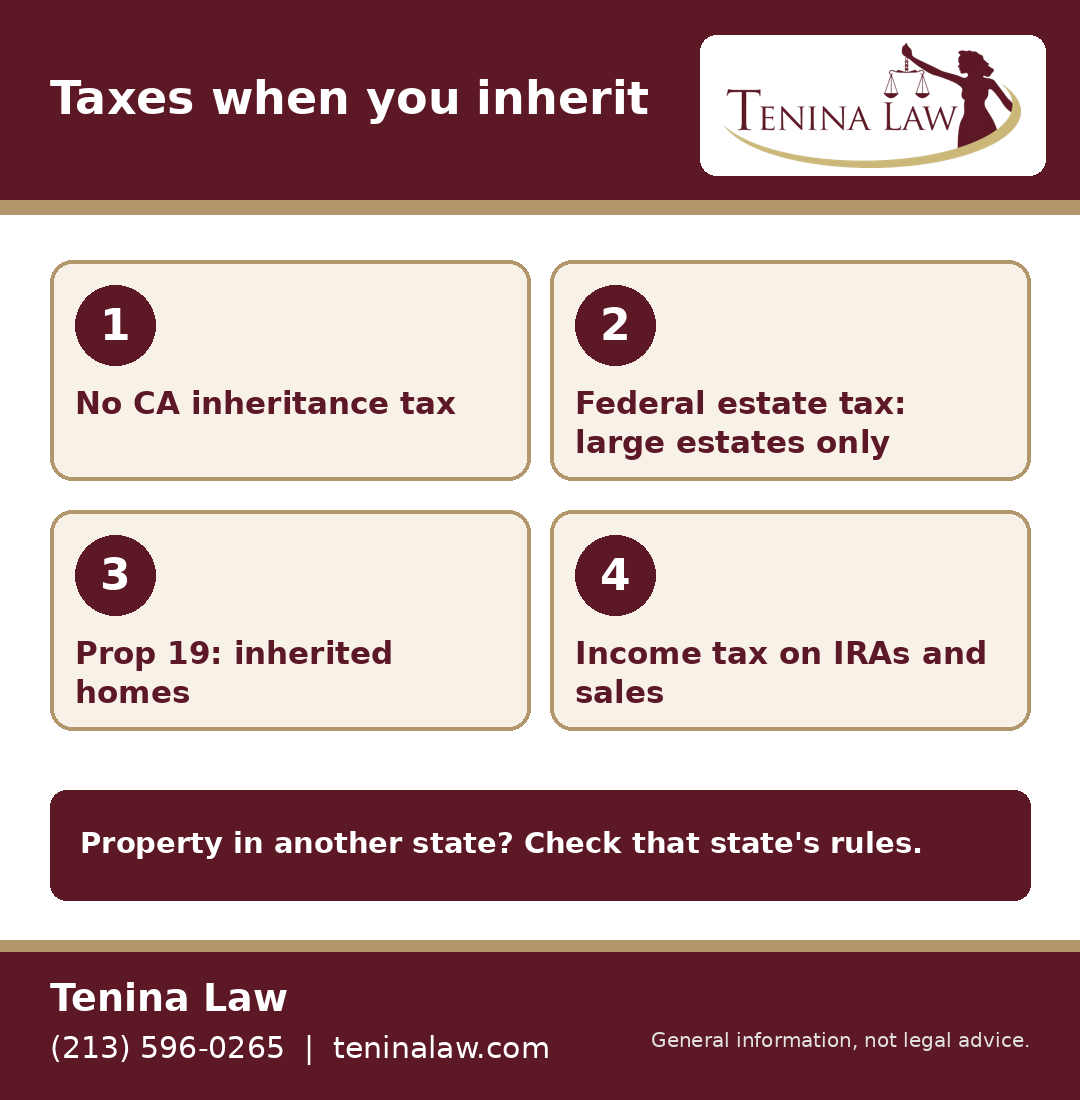
- California does not have an inheritance tax or a state estate tax.
- A federal estate tax can apply to very large estates, and it’s paid by the estate, not the heirs.
- Some other states do tax inheritances, so property or a relative in another state can change the picture.
- Inherited homes can face a new property tax value under Proposition 19 unless an exclusion applies.
- Inherited retirement accounts and the sale of inherited property can create income tax.
Does California have an inheritance tax?
No. Voters repealed the California inheritance tax decades ago, and the state has not brought it back. The state’s own tax board, the Franchise Tax Board, confirms there is no California inheritance tax or estate tax. You can read its guidance on the FTB website.
An inheritance tax is a tax the person who receives property pays. An estate tax is a tax on the estate itself before anything is passed on. California has neither one, which surprises many people who expect the state to take a share.
Can the federal estate tax still apply?
Yes, but only for large estates. The federal estate tax is charged on the value of an estate above an exemption amount set by Congress. That amount is high, and it can change when tax laws change, so most California families never owe it. The IRS explains the rules on its estate tax page.
If the federal tax does apply, the estate’s executor or trustee files the return and pays the tax from the estate. Heirs don’t usually get a separate bill. Married couples can often pass property to a surviving spouse without estate tax, and the surviving spouse may be able to use the unused part of the first spouse’s exemption. That step usually needs a timely federal estate tax return, even when no tax is due, so it’s worth asking about early.
What if a loved one lived in another state?
This is where an inheritance tax can show up. A small number of states still have an inheritance tax, and some have their own estate tax. The rules depend on where the person who died lived and where their property sits.
| Situation | What to check |
|---|---|
| The person who died lived in California. | No California inheritance or estate tax applies. |
| They owned a home or land in another state. | That state’s estate or inheritance tax rules may apply to that property. |
| They lived in a state with an inheritance tax. | You may owe that state’s tax even though you live in California. |
| The estate is very large. | The federal estate tax may apply no matter where you live. |
If any of these fit your family, it’s smart to talk with a lawyer before you sign anything or move money. The lack of a California inheritance tax doesn’t protect you from another state’s tax.
In a Hurry? Dial 213-596-0265 now!
How does Proposition 19 affect an inherited home?
For many California families, property tax is the real surprise. Proposition 19 changed how inherited homes are taxed starting in 2021. In the past, parents could pass a home to their children and keep the old, lower tax value in many cases. Now, that break is much narrower.
Under Proposition 19, a child who inherits a parent’s home can keep part of the old tax value only if the child moves in and makes it their main home within a set time. There’s also a cap on how much value can carry over, and anything above it is added to the new tax value. A rental or second home inherited from a parent is usually reassessed at its current value. The State Board of Equalization has more detail on the rules and the forms.
This can make a big difference in what it costs to keep a family home. Planning ahead with a California estate planning attorney can help you understand your options before the home changes hands.
Do you pay income tax on an inheritance?
Usually not on the inheritance itself. Cash or property you inherit is generally not counted as taxable income. But there are a few common exceptions:
- Retirement accounts. Money you take out of an inherited IRA or 401(k) is often taxed as income, and many heirs must empty the account within a set number of years.
- Selling inherited property. If you sell an inherited home or stock, you may owe tax on any gain. The good news is that the starting value is usually reset to the value on the date of death, which can lower the gain.
- Income the property earns. Rent, interest, or dividends earned after you inherit are taxable to you.
Because these rules can be tricky, it helps to keep records of the date-of-death value. Our team also handles tax law questions, which can help when an estate and a tax issue overlap.
How can good planning reduce tax surprises?
A clear estate plan can’t change the law, but it can help your family avoid mistakes. A living trust can help your loved ones avoid probate and keep property moving smoothly. Naming beneficiaries on retirement accounts and life insurance keeps those assets out of probate, too. And careful planning around a family home can help your children decide early whether to live in it, rent it, or sell it.
If you’re also thinking about who will make decisions for you if you can’t, our guide to power of attorney in California explains the basics.
Talk to a California estate planning lawyer
If you’ve inherited property, or you want to plan for your own family, we’re here to help. Call Tenina Law at (213) 596-0265 to schedule a free consultation at our Sherman Oaks office. This article is general information, not legal advice, and every family’s situation is different.
In a Hurry? Dial 213-596-0265 now!
Frequently Asked Questions
Q: Is there an inheritance tax in California?
A: No. California does not have an inheritance tax or a state estate tax.
Q: Do I have to pay taxes on money I inherit in California?
A: Usually not on the inheritance itself. But income from inherited retirement accounts and gains from selling inherited property can be taxed.
Q: Does Proposition 19 affect inherited homes?
A: Yes. A child can keep part of a parent’s lower tax value only if the child moves into the home as their main residence within the time allowed, and limits apply.
Q: Who pays the federal estate tax?
A: The estate pays it before property is passed on. It only applies to estates above the federal exemption amount.
Q: What if my parent lived in another state?
A: That state’s laws may apply. Some states have an inheritance tax, so talk to a lawyer before you take or sell property.