Here’s a phone call a lot of our clients get a few weeks after a crash. The other driver’s insurance adjuster calls and says something like, “Our investigation shows you were going over the speed limit, so you share responsibility.”
Most people assume that means their claim is over.
It doesn’t. At Tenina Law in Sherman Oaks, we explain California comparative negligence to injured people almost every week, and the first thing we tell them is this: sharing some fault rarely ends a case in this state. Here’s how it really works.
Key Takeaways
- California uses pure comparative fault, so you can recover even if you share some blame.
- Your recovery goes down by your share of fault.
- The insurer’s first fault number is just where they start.
- Get evidence early. It’s what moves the percentage.
In a Hurry? Dial 213-596-0265 now!
The Rule: Pure Comparative Fault
The rule comes from a 1975 California Supreme Court case, Li v. Yellow Cab Co.
Before Li, if you were even slightly at fault, you could be barred from recovering anything. Li changed that. California now follows what’s called pure comparative fault.
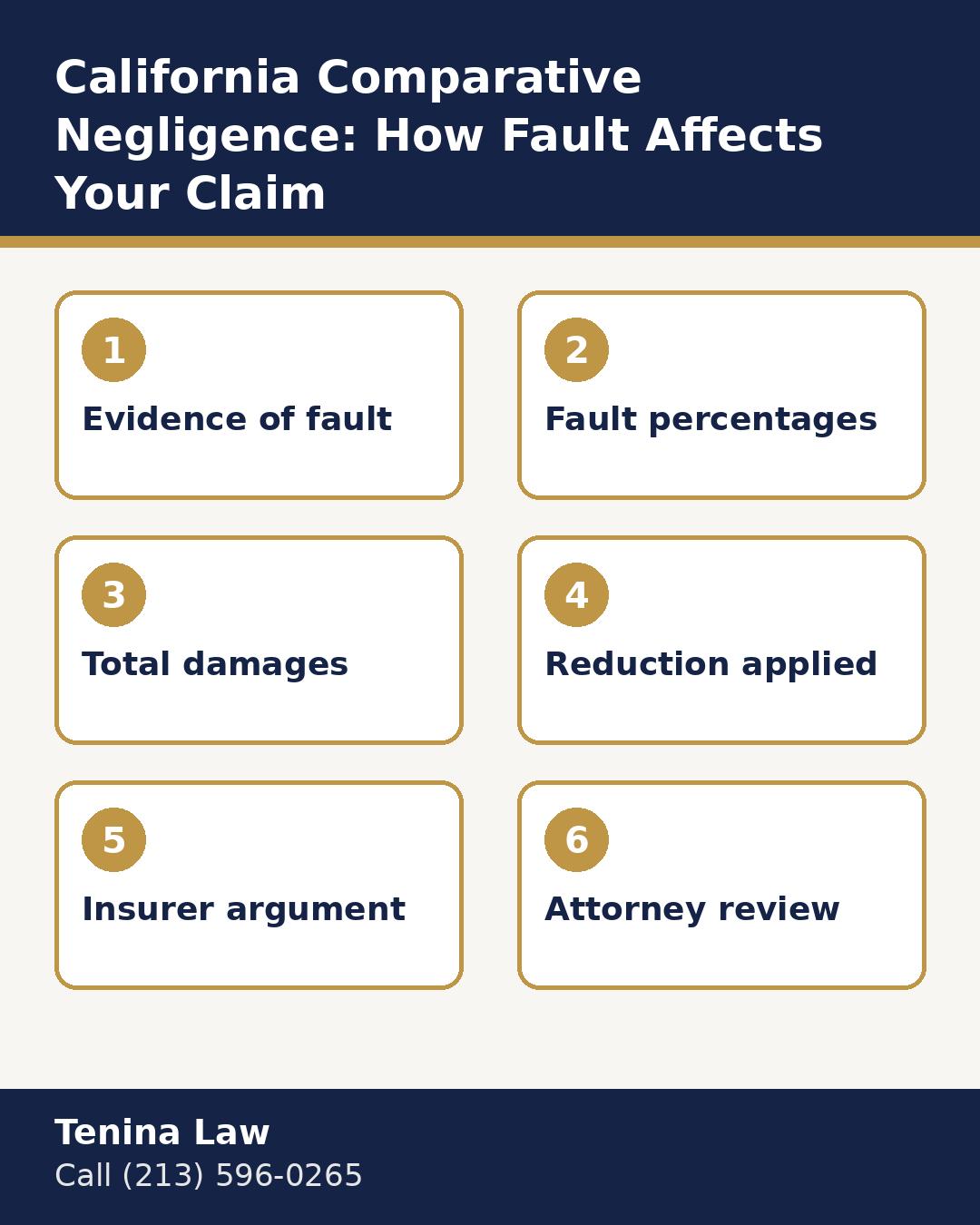
Each person’s share of blame gets weighed, and an injured person’s recovery is reduced by their own share. You can recover even if you were mostly at fault. Someone found 70 percent responsible can still recover 30 percent of their damages.
So the real question usually isn’t whether you can recover. It’s what percentage of fault lands on you.
How the Math Works
Say your total damages, including medical bills, lost wages and pain and suffering, add up to a certain amount.
If a jury finds you are 10% at fault, you recover 90 percent of that amount. At 50 percent, you’d recover half.
Every percentage point matters. That’s exactly why insurers start high and push.
The Insurer’s First Number Is an Opening Position
When an adjuster says you should carry half the fault, that’s where they’re starting, not where the evidence ends.
The real number gets built from evidence, and that’s where most of the work happens.
What Evidence Actually Moves the Number?

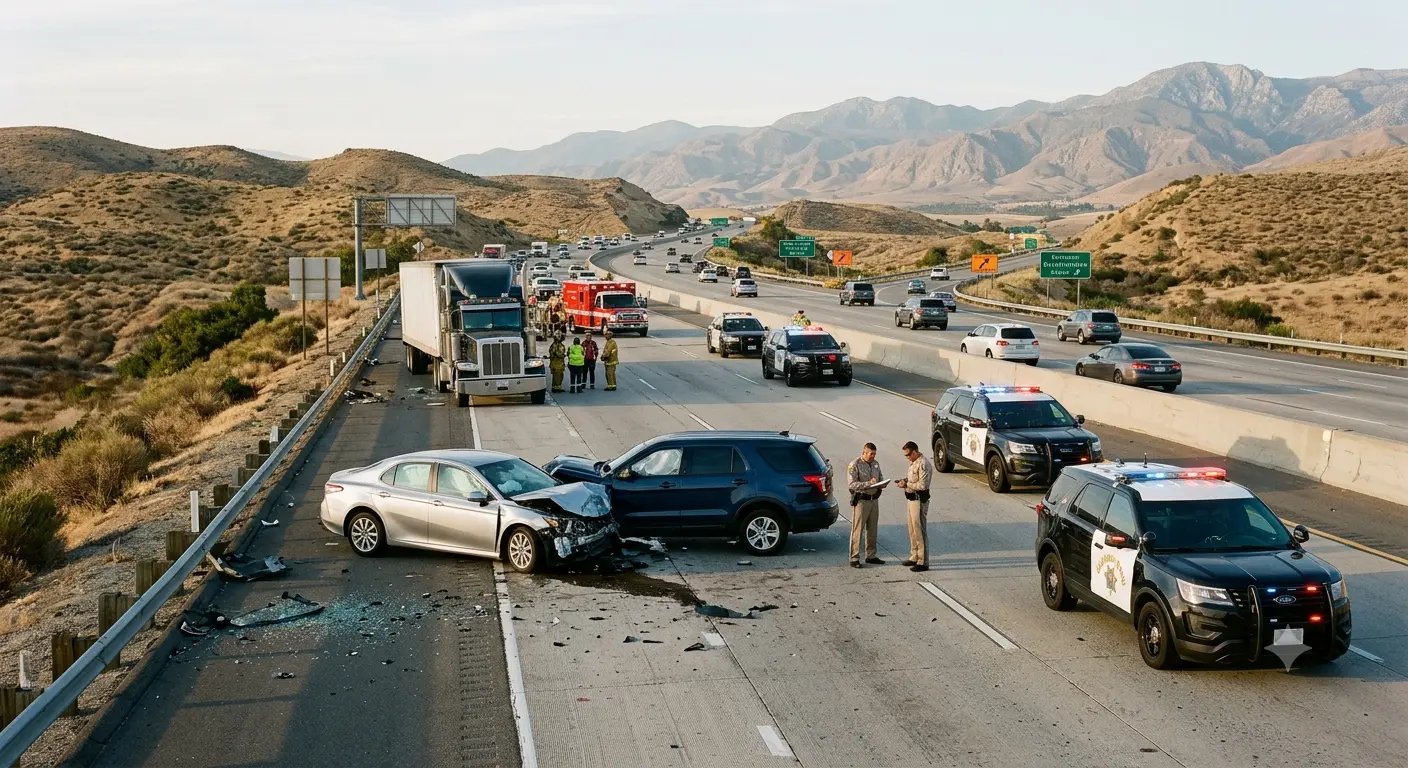
Take a common Los Angeles crash. A truck pulls out of a shopping center driveway on Ventura Boulevard into traffic, and a driver who may have been going a little over the limit can’t stop in time.
The adjuster points at skid marks and says “speeding.” But then the evidence comes in.
Security video from the shopping center might show the truck never stopped at the edge of the driveway. A camera at a business across the street gives a second angle. A reconstruction based on video frames and vehicle damage might show the driver was a few miles over the limit. That isn’t nothing. It’s also very different from “flying.”
Then there’s the rule the other driver broke. Drivers leaving a driveway or private road have to yield to traffic already on the street. Failing to yield is often the main reason a crash like that happens at all.
Witnesses help, too. Someone at a bus stop who saw the truck pull out without looking can change the whole picture.
Put together, evidence like that can shift a case from “you’re half to blame” to “the other driver carries most of it.”
Proposition 51: More than One At-Fault Party
California has another wrinkle. Proposition 51, passed in 1986, matters in cases with more than one at-fault defendant.
Each defendant pays economic damages, like medical bills and lost wages, jointly. But non-economic damages, like pain and suffering, are split by each defendant’s percentage of fault.
In a two-car crash, it may not matter much. In a multi-car pileup on the 405, it can matter a lot.
Proposition 213: Uninsured Drivers
A separate rule applies to drivers without insurance. Under Proposition 213, an uninsured driver generally can’t recover non-economic damages, even if the other driver was mostly at fault.
It’s one more reason to keep your coverage current.
What Helps You Most If They Say You Share Fault?
Get evidence early. Video from businesses and homes gets recorded over, sometimes within days. Witnesses move or forget.
Take photos of the scene, the cars and your injuries. Get the police report, though a judge or jury makes the final call on fault.
Be careful what you say to the other driver’s insurer. A casual “I might have been going a little fast” can turn into a recorded statement used to raise your percentage.
Get medical care right away and follow through. Gaps in treatment get used to argue your injuries weren’t serious.
And watch the clock. Most California personal injury claims must be filed within two years of the injury, with shorter deadlines when a government agency is involved.
Why We Don’t Take the First Offer at Face Value
Insurers know that most people have never dealt with a fault dispute before. A confident adjuster with a percentage ready can make it sound settled. It isn’t. Until a jury decides, or both sides agree, fault is just an argument, and arguments can be answered with video, photos and witnesses.
The Takeaway
In most California comparative negligence cases, that first percentage from the insurer is only a starting point. Evidence builds the real number, and a small share of fault on your side still leaves room for a meaningful recovery.
Please don’t walk away after one phone call.
Tenina Law helps injured people in Los Angeles and across Southern California push back when insurers use shared fault to lower an offer. Attorney Alla Tenina is licensed in California and has more than 20 years of civil litigation experience. You can read more about common defenses against car accident claims in California and what to do with an insurance company settlement offer on our site.
For more, see motorcycle accident claims in California, how to evaluate an insurance company settlement offer, multi-car accidents in California, Los Angeles car accident lawyer and contact page.
Talk to Tenina Law
Call (213) 596-0265 to talk about how California comparative negligence affects your claim. Our office is at 15250 Ventura Blvd, Suite 1200, Sherman Oaks.
In a Hurry? Dial 213-596-0265 now!
Frequently Asked Questions
Q: Can I recover if I was partly at fault in California?
A: Yes. California uses pure comparative fault, so your recovery is reduced by your share of fault but not eliminated.
Q: What if I was more than 50 percent at fault?
A: You can still recover, reduced by your percentage. California doesn’t bar recovery at 50 percent the way some states do.
This article is general information about California law and is not legal advice. Reading it does not create an attorney-client relationship. Every case is different, and prior results do not guarantee a similar outcome.