
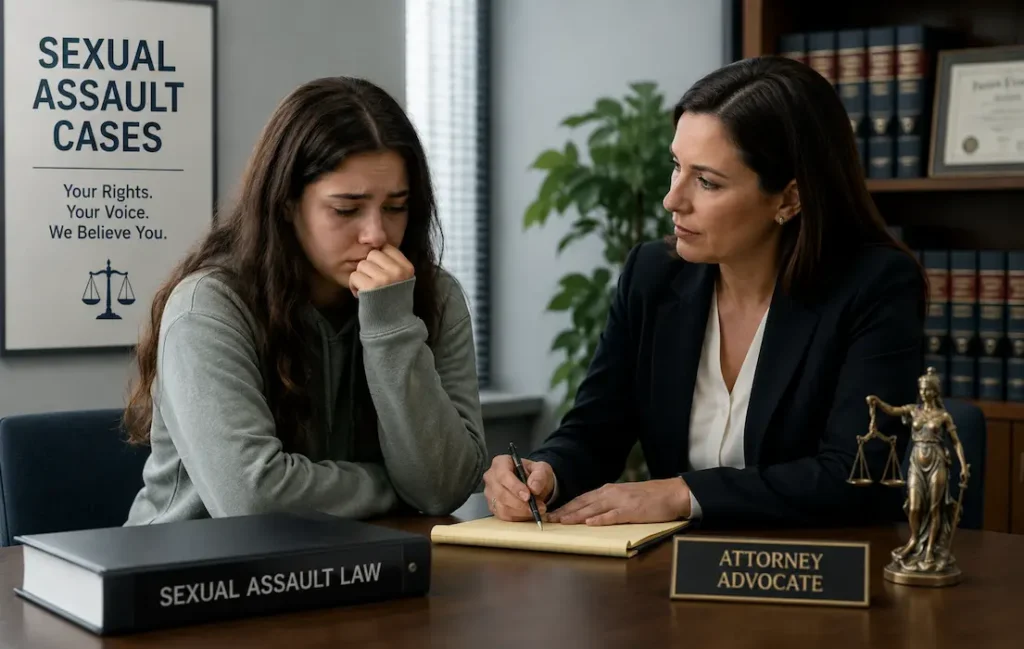
You cannot grasp the sea of sexual assault cases without peering behind their murky billows for a distance further than some casual review of Californian penal law. These proceedings are amongst the most complex and delicate moves within the American legal system, requiring a blend of expert statutory knowledge and acute psychological awareness. The experience of seeking justice is already, for survivors, a walk — some say a slog — through an oppressive maze, where it can seem that the legal machinery only adds to their burdens.
Our aim at Tenina Law is to navigate our clients through these systemic intricacies with surgical skill, confidentiality, and ardent representation. Finding the exact variables that make these issues so complicated is just the first step in determining how to proceed in the CA superior courts.
Key Takeaways
- Dissect the subtleties of non-verbal and trauma-based testimonials that do not hold up in a high-stakes deposition by a survivor.
- Investigate forensic timelines and digital footprints when physical evidence has been destroyed or time saps the information within.
- Fight back against defense strategies that seek to silence the plaintiff through societal bias or failed reporting times.
- Those should include fighting for orders of protection and the use of private hearings to help shield clients from the intrusiveness of public litigation.
The Intrinsic Nature of Litigation
Feel free to argue it out at dinner parties. Actually, sexual assault cases involve a defendant and the victim, much different from your everyday household tort or criminal run-of-the-mill dispute, which normally happens in public places. Put more simply, this absence of supportive eyes places the burden of proof squarely on the quality of individual narratives, barring immediate challenges in adhering to the required standard.
Often, the legal team has to contend with:
- Scant biological or physical evidence.
- Opposing counsel presents contradictory narratives
- Large gaps of time between the incident and making a formal report.
- How trauma affects memory retention and how it is able to be spoken.
All of these raise issues that need a custom law instead of a one-size-fits-all method.
The Evidentiary Hurdle
While evidence is the underpinning of any judicial result, in this particular field, it is historically fickle. The physical signs of assault are often transient, and if reported later, the chance for forensic collection may be lost completely. When such data does exist, it must be exhibited with an irrefutable chain of custody.
Secondary evidentiary streams often include:
- Comprehensive clinical assessments and medical documentation.
- Evidence analysis of encrypted digital communications and metadata.
- Testimony in Context about Turns of Behavior
- Testimony from psychologists specialising in post-traumatic stress.
Building a strong case involves looking into every factor, no matter how small.
The Implications of Delayed Reporting
It is an established fact that survivors delay reporting an incident. Much of the hesitation stems from fear of retaliation, trauma-induced paralysis, or a sworn distrust in the California legal bureaucracy.
These delays are, of course, human, but also add a particular usability friction when it comes to sexual assault cases:
- Reducing the time-sensitive biological material.
- Providing the defense a window to probe when this became so.
- Raising the difficulty of creating an unequivocal, linear order of facts
It requires a seasoned legal practitioner to successfully fill these time gaps while keeping the court informed as to why a delay occurred, yet ensuring that the case continues apace.
Consent: The Pivotal Legal Pivot
Consent remains the single most contentious redoubt in these proceedings. In court, it still comes down to whether affirmative consent was given—and how well-defined the environment in which it was solicited.
Legal analysis must scrutinise:
- Explicit or implied coercion and psychological manipulation
- Impaired condition, as in incapacity caused by intoxication or injury.
- The effects of professional hierarchies or power differences.
The difference between how the encounter looks and the actual situation on the ground.
The legal provision of consent is often rather nuanced, and thus it becomes the tipping point that determines the fate.
In a Hurry? Dial +1213-596-0265 now!
Psychological and Emotional Dynamics
They are not just names on a court docket; they represent seismic ruptures of human lives. Many of the survivors we represent have endured a veritable gauntlet of mental trauma that has at times even been disruptive to the litigation process itself.
Challenges often manifest as:
- Vivid panic as to cross-examination or reprisal.
- Dissociated memories due to brain defense mechanisms
- The high emotional cost of repeating over and over the experience through testimony (so-called “reliving”).
- The social overwhelm of facing an offender in a formal setting.
An appropriately managed version of these factors necessitates a legal team that takes as much care regarding the psychological constitution of the client as it does to technically prepare the filing.
The Shadow of Societal Stigma
But even behind the courtroom doors, the outside world continues to cast a long shadow over the path of a case. This is a foundational fear that prevents many from pursuing justice because they don’t want to be criticized, shunned, or treated as an outsider by the community.
This external pressure can impact:
- The willingness of a survivor to come forward and file in the first place.
- The willingness to cooperate over the course of a long and public trial
- Overcoming the trauma in their own long-term emotional future.
To combat these pressures, a firm needs to work behind the scenes with total privacy and an experienced hand at reputation management.
The Standards of Procedure and proof responsibilities
Each filing must endure the crucible of tough legal standards. The “beyond a reasonable doubt” threshold in criminal matters is an extremely high hurdle; The facts have to be air-tight.
This necessitates:
- The offering of good, clear evidence.
- Evidence that does not falter in the flames of a blistering cross-examination.
- One story that is well-reasoned and procedurally perfect.
The burden of proof may be changed slightly in civil litigation, but the arguments are no less complicated, and you still need a master of the courtroom.
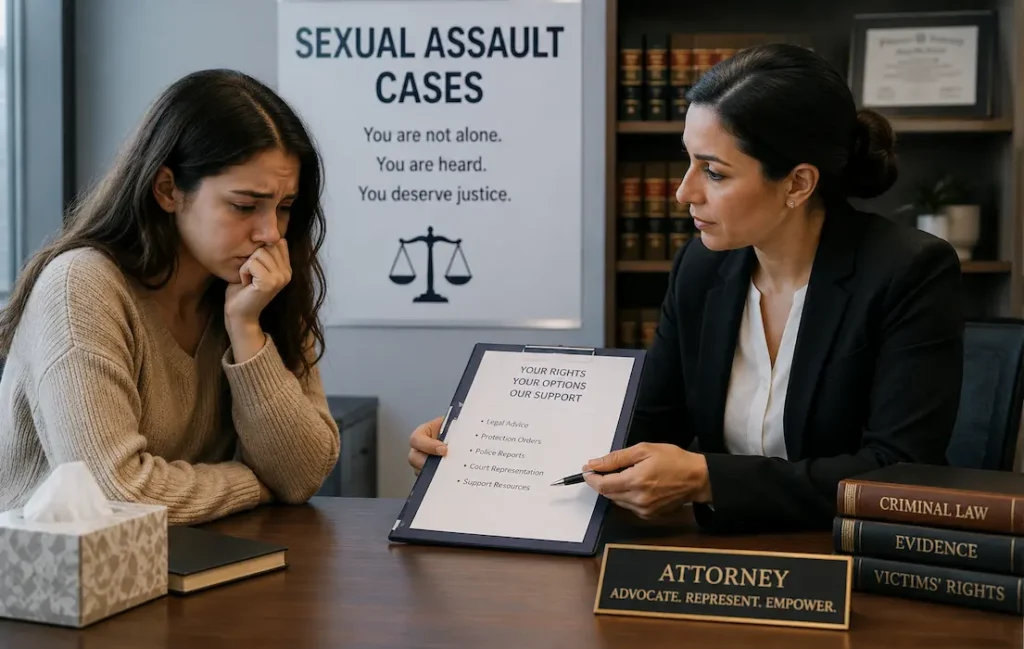
The Necessity of High-Authority Representation
With the variety of challenges available, attempting to sail these waters without top-level counsel is a gamble. The technical aspects of the law are too inflexible to handle, while at the same time, processing what happened.
Tenina Law offers:
- Advanced navigation around the CA justice system.
- Careful protection of sensitive and privileged information.
- Forensic investigation and data-driven case development
- Strong constitutional defense of an individual’s rights in state and federal courts.
We are the shield and the sword, ensuring that the legal machine supports the survivor rather than vice versa.
Resolution and Justice
The road through sexual assault cases is a long one, but if you know the legal mechanics, then there are ways of traversing it more safely and confidently. Each case is unique, and in the right hands, the system can be utilized to achieve a tangible outcome.
If you operate in this highly charged space, rest assured that the importance of sophisticated, balanced, and authoritative advice is foremost in the minds of those at Tenina Law. So if you need a partner who knows how serious your position is, then speak to Tenina Law right away for help with your case and relief from your fight for the justice that you rightly deserve.
In a Hurry? Dial +1213-596-0265 now!
FAQ
Q: Why is it so hard to prove these cases?
A: For those cases that wind their way into court, they frequently rest upon a “he-said, she-said” and a paucity of tangible evidence requiring an astute approach to circumstantial evidence.
Q: Once years have passed, can you still go after a case?
A: Yes, but delays can complicate evidence collection. We make cases that have time on their side.
Q: What is the need for a specific attorney?
A: An expert knows how to keep your rights safe and navigate the unique procedural landmines defense teams deploy to sabotage a case.
Q: What differences exist between civil and criminal proceedings?
A: Criminal Cases = state punishment (you go to prison) and civil cases = self-punishment of liability for harm caused to victim(s), we can help you on either route.